🟦 CHAPTER 4: WHO TRADES FOREX? Understanding the players that move the $7.5 trillion FX market.
- shrinivas yamawad
- Dec 3, 2025
- 3 min read


⭐
4.1 Introduction
The Forex market is massive, but it is not controlled by one person or one institution.
Millions of participants trade currencies daily — but some players have more power than others.
To become a consistently profitable trader, you must understand:
Who moves the markets
Who follows the market
Who gets trapped
Who creates liquidity
Who consumes liquidity
Different market participants → different motives → different impacts on price.
⭐
4.2 The 6 Main Types of Forex Participants

1️⃣ Central Banks
2️⃣ Commercial Banks
3️⃣ Hedge Funds & Financial Institutions
4️⃣ Corporations (Export/Import Companies)
5️⃣ Liquidity Providers & Brokers
6️⃣ Retail Traders (individual traders like you)
Let’s understand each one clearly.
⭐
4.3 Central Banks – The Most Powerful Players

Examples:
U.S. Federal Reserve (USD)
European Central Bank (EUR)
Bank of England (GBP)
Bank of Japan (JPY)
Reserve Bank of India (INR)
What they do:
✔ Set interest rates
✔ Control inflation
✔ Strengthen or weaken their currency
✔ Intervene in USD, EUR, GBP, JPY markets
Impact on traders:
When a central bank speaks, the market explodes — especially GOLD (XAUUSD), USD pairs, and JPY pairs.
They create some of the strongest moves in the market.
⭐
4.4 Commercial Banks – The Real Market Makers

These banks trade billions daily:
JP Morgan
Citibank
Deutsche Bank
HSBC
Barclays
They make up the interbank forex market, which controls most global liquidity.
What they do:
Buy and sell currencies for clients
Trade for profit
Move billions in milliseconds
Create liquidity zones
Influence trend direction
Impact:
Commercial banks create the big waves that retail traders try to ride.
⭐
4.5 Hedge Funds & Investment Firms

These institutions trade Forex to generate high returns for investors.
They include:
Hedge funds
Investment funds
Proprietary trading firms
What they do:
✔ Use advanced algorithms
✔ Hunt liquidity
✔ Enter large positions
✔ Influence big moves on Gold, NAS100, and major pairs
These players follow smart money concepts —
and retail traders often lose by trading against them.
⭐
4.6 Multinational Corporations

Examples:
Apple
Toyota
Amazon
Tata
Samsung
Why they use Forex:
Paying international employees
Buying raw materials
Hedging currency risks
Handling import/export transactions
They don’t trade for profit — they trade for business operations — but they still influence price.
⭐
4.7 Liquidity Providers & Brokers
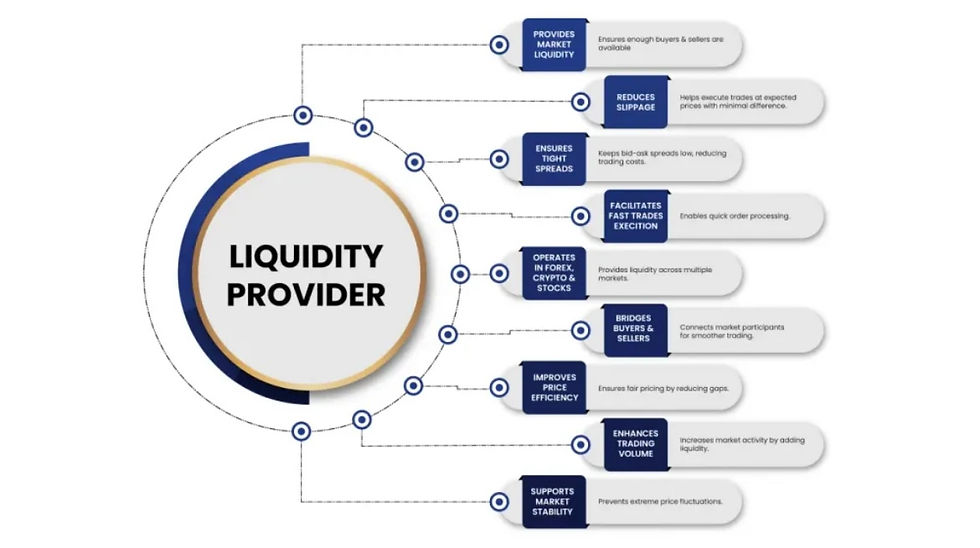
Liquidity Providers (LPs) connect:
Banks ←→ Brokers ←→ Traders
Top LPs include:
Goldman Sachs
Morgan Stanley
IC Markets LP
LMAX
CitiFX
What they do:
✔ Provide price quotes
✔ Provide buy/sell liquidity
✔ Bridge between markets
✔ Ensure orders get filled
Without LPs, Forex would not function smoothly.
⭐
4.8 Retail Traders (Individual Traders)

MT4
MT5
cTrader
Prop firm accounts
Retail traders make up 5–10% of daily volume.
Characteristics:
Use small capital
Often emotional
Often lack discipline
Frequently hunted for liquidity
Most retail traders lose money because:
✔ They trade against the trend
✔ They use huge lot sizes
✔ They fall for fake breakouts
✔ They don’t understand institutional behavior
But with proper education, retail traders can be very profitable.
⭐
4.9 So Who Actually Moves the Market?

Market movers:
✔ Central Banks
✔ Commercial Banks
✔ Hedge Funds
✔ Liquidity Providers
These players cause:
Major trends
Sharp reversals
Liquidity grabs
Fake breakouts
Retail traders never move the market.
They only react to what big players do.
⭐
4.10 Why This Knowledge Matters for You
Understanding who trades Forex helps you:
✔ Avoid trading against smart money
✔ Identify where liquidity sits
✔ Understand why fake breakouts happen
✔ Follow institutional flow
✔ Improve your win rate
Most retail traders lose because they think the market moves randomly.
But the truth?
The market moves based on institutional behavior — NOT retail behavior.
If you learn to read institutional movement (order blocks, liquidity, BOS/CHOCH), you will trade with the big players.


Comments